




The 2026 Atlantic hurricane season starts June 1, and for Lake County homeowners that single date reshapes the year. Florida hurricane preparedness looks different here than on the coast — the threats inland are wind, tornadoes, tree fall, and the kind of prolonged power outage that turns a manageable inconvenience into a real safety problem. Storm surge is not on our list. Everything else still is.
This guide walks through what to do before, during, and after a storm, with a practical eye toward homeowners on a fixed income and the everyday medical and mobility realities that come with that. It is built around the 2026 forecast, the rules and resources that actually apply to inland Central Florida, and the specific phone numbers you should program into your phone tonight. If you have already worked through our companion 2026 energy efficient homes guide, much of the insurance-mitigation logic carries over directly.
The 2026 Outlook: What NOAA and CSU Are Calling For
NOAA’s 2026 Atlantic hurricane outlook, released May 21, calls for a below-normal season — 8 to 14 named storms, 3 to 6 hurricanes, and 1 to 3 major hurricanes. The agency cites the developing El Niño and weaker trade winds as the main drivers. Colorado State University’s April forecast lines up: 13 named storms, 6 hurricanes, 2 major hurricanes, well below the long-term averages of 14.4, 7.2, and 3.2.
However, the long Florida record makes one thing clear. A “below-normal” season is still a hurricane season. Florida hurricane preparedness is not a probability bet — it is a single-event contingency plan. Hurricane Andrew in 1992 hit during a below-average season. Hurricane Milton, in October 2024, spawned 46 confirmed tornadoes across the state in a single day. One storm in Lake County is enough to matter.
Therefore, the right way to read the 2026 outlook is as a planning signal, not as permission to stand down. The season runs through November 30, and NOAA updates its outlook in early August before the historical peak. Sign up for alerts now, check back in midsummer, and treat Florida hurricane preparedness as a year-round household discipline rather than a June-only project.
Why Florida Hurricane Preparedness Looks Different in Lake County
Lake County sits 40 to 60 miles from either coast. The county is not in any coastal evacuation zone, and the threats here are different from Tampa Bay or Naples. Storm surge, the leading cause of hurricane deaths nationally, is not a Lake County risk. Wind, tornadoes, tree fall, prolonged outages, and inland rainfall flooding are. That difference reshapes Florida hurricane preparedness from “leave by Friday” to “be ready to stay put for a week.”
That changes the preparation calculus. Inland homeowners rarely evacuate. As a result, the right plan is to harden the home, stock for an extended shelter-in-place, and prepare for the moment the lights go out and stay out. Mobile and manufactured-home residents are an exception — local officials may still issue mandatory evacuations for those structures even in Lake County. Lady Lake’s town government publishes its current emergency procedures at the Lady Lake Emergency Preparedness page.
Additionally, neighbors here should think about post-storm isolation. After Hurricane Milton in 2024, Duke Energy Florida restored 95% of its non-hardest-hit customers within 96 hours of landfall — a four-day window is the realistic planning baseline for inland Central Florida. SECO Energy reported approximately 85,000 outages from Milton alone. Plan around that number. The single best Florida hurricane preparedness investment for inland homeowners is the kit and the resilience to wait those four days comfortably.
Before the Storm: The Florida Hurricane Preparedness Checklist That Matters
The Florida Division of Emergency Management raised its kit recommendation in 2025 to at least 7 days of non-perishable food and water per person, up from the older 3-day baseline. Ready.gov still anchors the water number at 1 gallon per person per day for drinking and sanitation. For inland Central Florida, where extended outages and supply-chain delays are routine, plan toward the higher end.
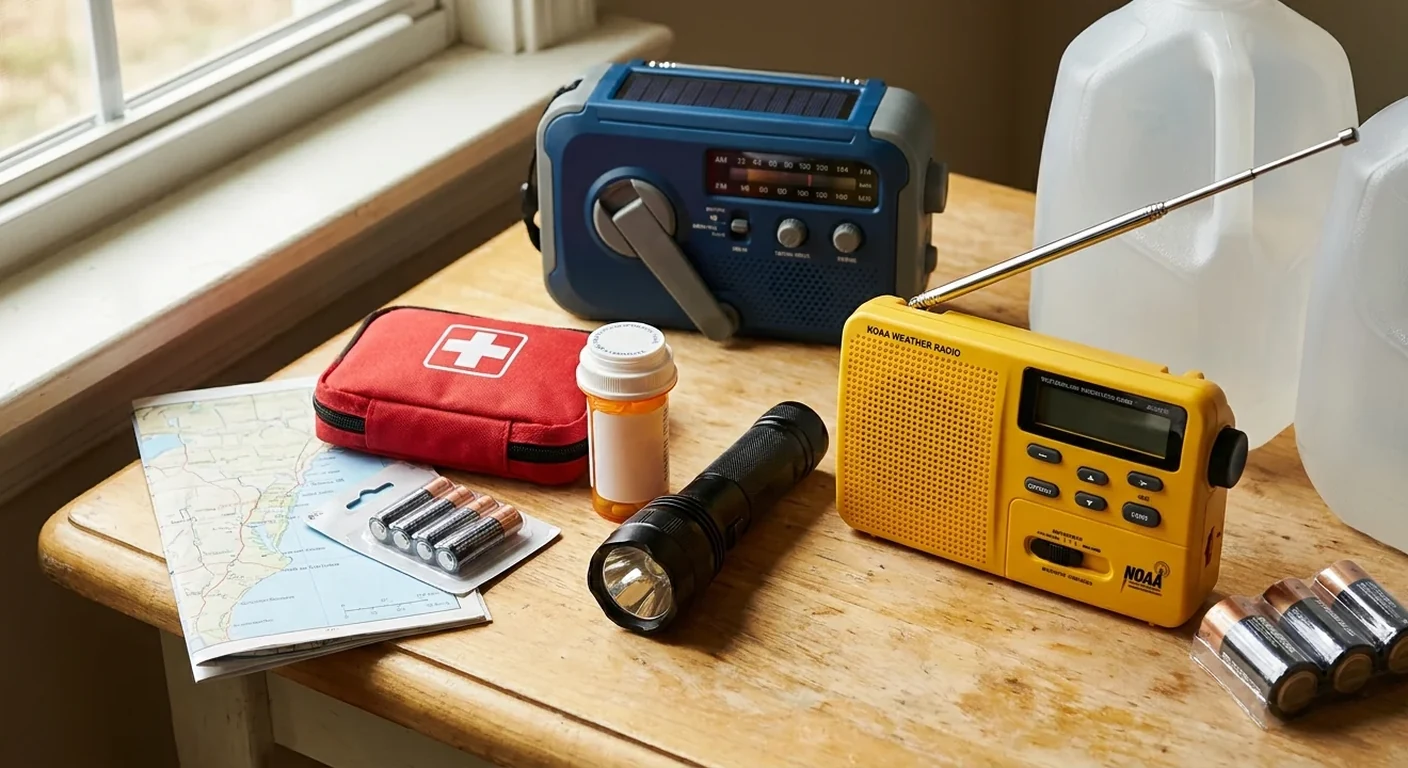
Florida hurricane preparedness supplies to confirm now, before the first watch is issued:
- Water: at least 7 gallons per person; double for pets and medical needs.
- Food: 7 days of non-perishable items per person; manual can opener.
- Power: battery-powered or hand-crank NOAA Weather Radio, flashlights, fresh batteries, two power banks per household.
- Medical: 14-day supply of every prescription medication, a printed list with dosages, and copies of insurance cards.
- Documents: insurance policies, deed, IDs, and a recent home inventory in a waterproof container or cloud folder.
- Cash: small bills for the first 72 hours, since ATMs go offline with the power.
- Pets: 7 days of food, water, current vaccination records, carrier or leash.
Florida also made disaster-preparedness sales tax exemptions permanent in 2025. There is no temporary “tax holiday” to wait for in 2026. Year-round exempt items include batteries, smoke detectors, carbon monoxide alarms, certain portable generators, and insect repellent. Buy now and store before the first watch — the shelves clear in 24 hours when a storm is named.
Outside the home, walk the property. Trim weak limbs, secure or stage lawn furniture for fast indoor staging, clear gutters, and identify what becomes a projectile in 90-mile-per-hour wind. A well-managed Florida landscape is also a safer one — our Florida-friendly landscaping guide covers plant choices that hold up better in storm conditions. This kind of seasonal yard work is the most overlooked piece of Florida hurricane preparedness.
The Special Needs Registry and the 14-Day Medication Rule
Two state programs matter more for inland 55-plus homeowners than almost any other piece of Florida hurricane preparedness. The first is the Florida Special Needs Registry. Residents who depend on oxygen concentrators, nebulizers, feeding tubes, or who live with progressive cognitive conditions can pre-register with local emergency managers so a transportation and shelter plan is in place when a storm is named. Registration closes 72 hours before tropical-storm-force winds arrive, so do this in May or early June, not the week of the storm.
Importantly, registration does not automatically guarantee shelter admission, and a special-needs shelter is not the same as a hospital. The program connects residents with local resources and ensures they are not forgotten in an evacuation order. For Lake County homeowners with medical considerations, this single step is the most important piece of Florida hurricane preparedness on the list.
The second is Florida Statute §252.358, which requires insurers to authorize up to a 30-day prescription refill, regardless of recent refill history, when a hurricane warning or a governor’s state of emergency is in effect in your county. In practice that means: call your pharmacy as soon as the warning posts, and the emergency refill is available. The Florida Division of Emergency Management recommends keeping a rolling 14-day supply of every prescription on hand year-round — the longer baseline matters because inland pharmacies can be closed for days after a storm.
During the Storm: Shelter in Place, Watch the Wind
Once a hurricane warning is in effect for Lake County, the work shifts from preparation to safety. Bring everything inside the home that can move. Move to an interior room — typically a hallway, closet, or bathroom — on the lowest floor, away from windows. Keep a weather radio on, conserve phone battery, and avoid using landline phones during active lightning. The during-storm phase of Florida hurricane preparedness is short — usually 6 to 12 hours — but it demands strict discipline.
Therefore, the most dangerous hours are often after the eye passes. Wind can reverse direction in minutes and damage already-stressed trees and roofs. Stay inside until local emergency management declares all-clear. AlertLake, the county’s Everbridge-powered alert system, is the fastest way to receive county-wide guidance on power, road status, and shelter information.
If a tornado warning is issued — and 2024 demonstrated how common this is in Central Florida during landfalling hurricanes — move immediately to a small interior room with no windows and protect head and neck. Hurricane Milton spawned 46 confirmed tornadoes statewide on landfall day, three of them EF-3 strength.
After the Storm: Generators, CO Safety, and Recovery
The single biggest cause of preventable death after a Florida hurricane is not the storm itself. The U.S. Consumer Product Safety Commission estimates roughly 85 to 92 portable-generator carbon monoxide deaths per year nationally. A CDC study of Florida’s 2004 hurricane season documented 167 nonfatal and 6 fatal CO poisonings — portable generators caused all six fatal incidents, with 34% of incidents involving generators inside garages and 12.8% inside the home itself.
Therefore, generator safety is non-negotiable. Operate every portable generator at least 20 feet from the home, with the exhaust pointed away from windows and doors. Never run a generator in a garage, even with the door open, and never inside the home. Install a battery-powered carbon monoxide alarm on every level. CO is colorless and odorless; the alarm is the only warning that works while you sleep. Treat CO awareness as core Florida hurricane preparedness, not an afterthought.
Document any damage thoroughly before cleanup begins. Photograph everything — exterior, interior, and contents — from multiple angles. Save receipts for emergency repairs. Standard Florida homeowners policies do not cover flood damage, even from hurricane rainfall, so if water enters the home from the ground rather than the roof, document that distinction carefully.
Insurance, Deductibles, and What’s Permanent in 2026
Florida’s homeowner insurance market is the financial side of every storm and an underappreciated layer of Florida hurricane preparedness for fixed-income households. Citizens Property Insurance, the state-backed insurer of last resort, uses a percentage-based hurricane deductible — typically 2%, 3%, 5%, or 10% of dwelling coverage — rather than a flat dollar figure. On a $400,000 policy, a 5% hurricane deductible is a $20,000 out-of-pocket hit before the insurer pays a cent. That deductible only triggers when the NHC officially designates a system as a hurricane.
However, the same mitigation features that reduce wind damage also unlock real premium discounts. Florida Statute §627.0629 requires insurers to provide discounts for verified wind-loss mitigation, documented on Form OIR-B1-1802. The Florida Office of Insurance Regulation publishes a current guide at FLOIR’s hurricane season resources page.
Additionally, the My Safe Florida Home program is still active and funded, and it remains the highest-dollar Florida hurricane preparedness incentive on the table. It offers free wind-mitigation inspections and matching grants up to $10,000 (the state contributes $2 for every $1 the homeowner spends) for impact windows, hurricane shutters, and roof reinforcement. The Florida Legislature allocated $280 million for fiscal year 2025-26, and the proposed FY 2026-27 budget calls for $600 million to clear a 45,000-applicant backlog. If you have not applied, do it now — the program has reopened windows for new applications historically, but a 45,000-application queue is real.
Lake County Florida Hurricane Preparedness Resources to Save Now
Local information moves faster than national news in a storm. Save these numbers and websites before June 1, not during the watch.
- Lake County Office of Emergency Management — 315 W. Main St., Tavares, FL 32778. Citizen information line during activations: 352-253-9999. Administrative office: 425 W. Alfred St., Tavares. Phone: 352-343-9420.
- AlertLake — alertlake.com. Free email, text, and voice alerts for severe weather, road closures, and evacuations.
- Town of Lady Lake — Town Hall: 409 Fennell Boulevard, Lady Lake, FL 32159. Phone: 352-751-1501. Email: hello@ladylake.org.
- Lady Lake emergency SMS alerts — text “LadyLakeFL” to 38276.
- Florida Special Needs Registry — snr.flhealthresponse.com.
- National Hurricane Center — nhc.noaa.gov. The single source of truth for storm tracking.
- Ready.gov hurricane kit — ready.gov/kit. Federal preparedness checklist.
- My Safe Florida Home — mysafeflhome.com. Free inspection plus matching grant application.
The Bottom Line for Florida Hurricane Preparedness in 2026
The 2026 season is forecast to be below normal, but every season hides one bad day. Florida hurricane preparedness in Lake County is less about evacuation and more about being able to wait out four days of wind, rain, and silence with food, water, medication, power, and a plan. The work to get there is a one-week project in May, not a six-hour scramble the night before landfall. Real Florida hurricane preparedness rewards calm preparation now.
At Green Key Village in Lady Lake, every home is built to current Florida Building Code wind standards, and the community is designed for the kind of resilient, low-maintenance living that holds up well when a storm passes through. If you want to see what that looks like in practice, explore our 2026 net-zero homes guide or schedule a tour when you are ready.
Sources
- National Oceanic and Atmospheric Administration. NOAA Predicts Below-Normal 2026 Atlantic Hurricane Season, May 21, 2026. noaa.gov
- Colorado State University Tropical Weather and Climate Research. Atlantic Hurricane Forecast, April 2026. tropical.colostate.edu
- Florida Division of Emergency Management. 2026 Florida Hurricane Preparedness Week and Updated Kit Guidance. floridadisaster.org
- Florida Division of Emergency Management. Personal and Family Plans — Medication. floridadisaster.org/planprepare
- Florida Department of Health Special Needs Registry. snr.flhealthresponse.com
- Florida Board of Pharmacy. Emergency Prescription Refills Under State of Emergency. floridaspharmacy.gov
- U.S. Centers for Disease Control. Carbon Monoxide Poisonings After Hurricanes — Florida, 2004. cdc.gov
- U.S. Consumer Product Safety Commission. Hurricane Season Generator Safety. cpsc.gov
- Citizens Property Insurance Corporation. Hurricane Deductibles. citizensfla.com
- Florida Office of Insurance Regulation. Hurricane Season Resources. floir.gov
- My Safe Florida Home Program. mysafeflhome.com
- Town of Lady Lake. Emergency Preparedness. ladylakefl.gov
- Lake County, Florida Office of Emergency Management. lakecountyfl.gov
- Duke Energy Florida. 2024 Hurricane Response and Restoration Filing. news.duke-energy.com
- Ready.gov. Build a Kit. ready.gov/kit